TubeInflation and LayeredTube
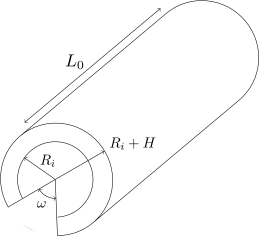
We consider a cylinder of reference inner radius \(R_i\), thickness \(H\), opening angle \(\omega\) (i.e., the stress-free state is an “open” cylinder of an angle \(2\pi-\omega\)), and length \(L_0\). When deformed state, the cylinder is “closed” and stretched along the length by \(\lambda_Z\). Cylindrical coordinate system is used with the first coordinate being radial, second being the circumferential, and third along the length. The material is assumed to be incompressible. As a result, when the deformed inner radius is \(r_i\), any point which was at radius \(R\) in the reference configuration moves to a deformed radius given by
where \(\kappa=2\pi/(2\pi-\omega)\). Thus, in cylindrical coordinates, the deformation gradient at any point is given by
As a result, the Cauchy stress tensor can be calculated at any point (without the Lagrange multiplier \(p\) term). The pressure difference between inside and outside of the artery can then be written as:
This integral is evaluated numerically. If the fiber directions are not symmetric about the length of the cylinder, there could be shear stress components. However, these are neglected. Lastly, from the pressure difference \(\Delta p\), force acting on the cylinder can be calculated as \(f = 2\pi r_i L_0 \lambda_Z\). The deformation can be written in terms of either the inner radius \(r_i\), the radius stretch \(r_i/R_i\), change in internal radius \(\Delta r_i = r_i - R_i\), or the deformed (internal) luminal area of the cylinder \(A = \pi r_i^2\).
Given deformation (in terms of inner radius/radius stretch/change in
radius, or deformed luminal area), the force measure can be calculated
using SampleExperiment.disp_controlled() function.
Conversely, given pressure difference or force, any of the
deformation metric are solved iteratively via SampleExperiment.force_controlled() function.
Lastly, the Cauchy stress tensor can be calculated by calculating the Lagrange multiplier \(p\) (which will vary across the thickness) by assuming the pressure on the external surface as zero, thus:
where \(\bar{\sigma}_{rr}(R)\) is the Cauchy normal stress in the
(first) radial direction without the Lagrange multiplier term. Once
\({p}(R)\) is known, all components of stresse tensors at any radius
can be calculated using the usual definition of Cauchy stress via
SampleExperiment.TubeInflation.cauchy_stress()
function.
TubeInflation samples can be “layered” via
LayeredTube. Such a setup can be used for representing, for example,
tissues that have multiple layers with different material models and
possibly even incompatible reference radius. The result would be that
there is no zero stress state for the layered sample. If the reference
compatibility is desired (i.e., if the reference state of each layer is
desired to also be the equilibrium of the combined layered state), then
the radius and thickness of each layer should be chosen appropriately.
Specifically, the outer reference radius of the innermost layer should
be the inner radius of the second layer, and so on.